ElevenLabs offers a 22% recurring affiliate commission with a 90-day cookie. This review is based on extensive testing of the platform across voice cloning, video dubbing, and music generation features, conducted in April 2026.
ElevenLabs released ElevenCreative in early 2026 as a unified creative production platform, and it represents a meaningful shift in what the company wants to be. For most of ElevenLabs' existence, they've been known for one thing done incredibly well – text-to-speech that sounds more human than you'd expect from a computer, with 10,000-plus voices, voice cloning that requires just 30 seconds of audio, and expressive generation that lets you add tone and emotion inline. ElevenCreative wraps that core strength around video creation, dubbing, music generation, sound effects, and conversational AI agents, all in one interface. I spent the last two weeks running ElevenCreative projects alongside Synthesia, HeyGen, and some raw video editing with RunwayML to see whether consolidating all this into one platform is actually worth it, or whether you're better off keeping your video tool separate from your voice tool. What I found is that ElevenCreative does some things remarkably well – but it's not the platform I would recommend to everyone, and the reasons are probably more subtle than you'd think.
What ElevenCreative Is and Why ElevenLabs Built It
ElevenCreative is essentially ElevenLabs' answer to the question of what happens when you stop thinking of voice generation as a feature that lives inside other people's products and start treating it as the foundation of an entire creative suite. The platform includes text-to-speech voice generation with 70-plus languages, instant voice cloning from 30 seconds of audio, video creation and AI avatars, video dubbing and translation, AI music and sound effects, conversational agents for voice interaction, and an audio editor for fine-tuning. You can generate a complete marketing video with voiceover, dubbed into multiple languages, with background music and sound design, all without leaving the platform – which is conceptually elegant, even if the execution has trade-offs.
The business logic here makes sense. ElevenLabs already had the best voice tech on the market. Customers were using ElevenLabs for voiceovers, then leaving to finish video work in DaVinci Resolve or Synthesia or HeyGen. Building out the video and music generation capabilities in-house meant they could capture that entire workflow and build a moat around the voice tech they're already known for – instead of competing with dedicated video platforms, they're building something that works because the voice is genuinely better than what you'd get anywhere else.
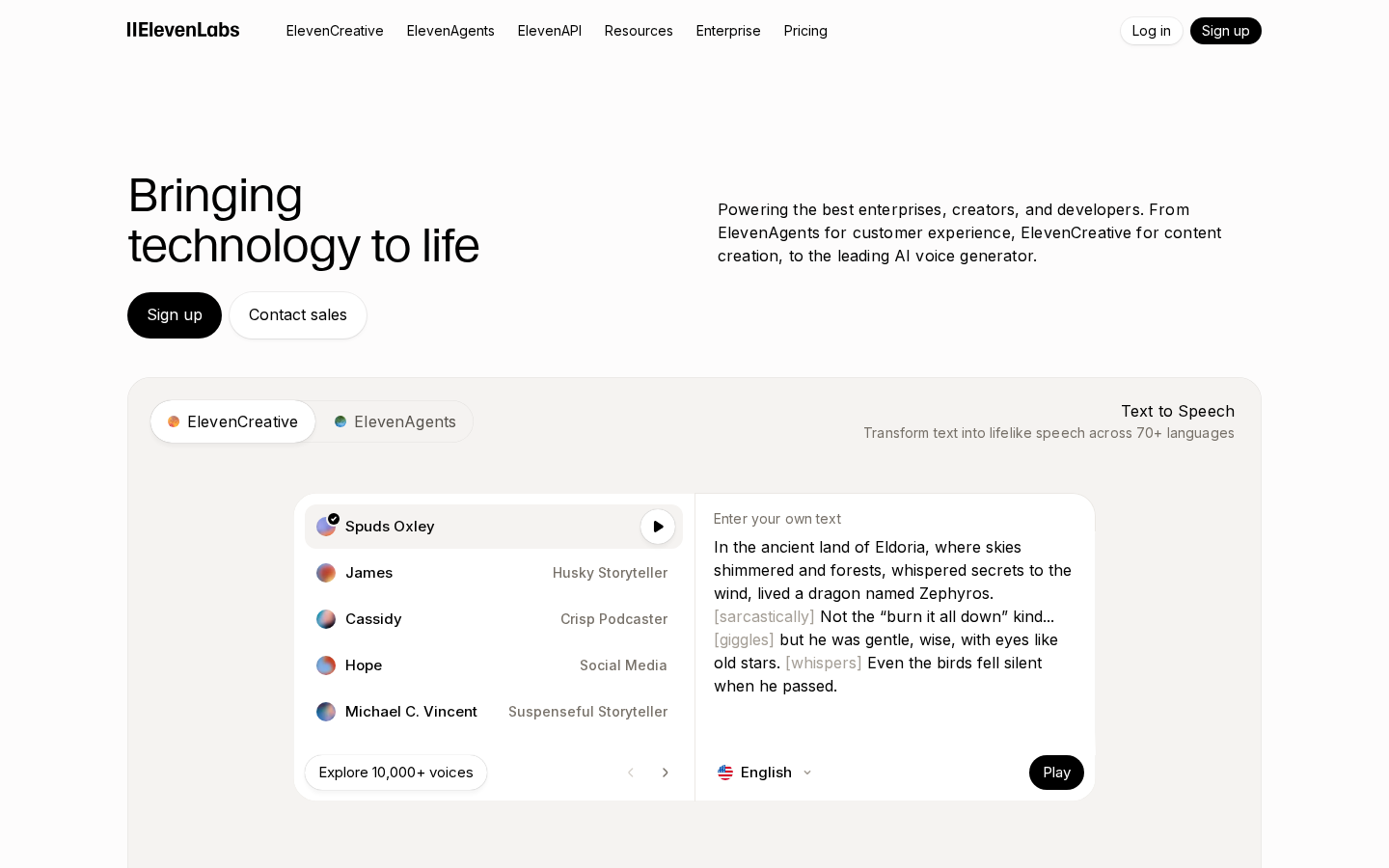
The Eleven v3 model, which shipped as the default in early April, introduced something called expressive audio tags that lets you write inline prompts directly into your script – things like [whispers] or [laughs] or [sighs] – and the model interprets those as generation instructions rather than text to be spoken. This feels like a small feature in isolation, but it fundamentally changes what's possible in voice work, because you can embed emotional intent directly into the script without needing a separate parameter or multiple generations. I tested this in a customer testimonial video and got output that felt genuinely natural in ways that earlier models didn't.
Voice Cloning and Voice Generation – The Core Strength
This is where ElevenCreative genuinely separates from the competition, and I want to be clear about that from the start. The voice generation quality is exceptional – I ran the same script through ElevenCreative, Synthesia, and HeyGen's voice synthesis, and ElevenCreative's output was noticeably more natural. There's less of that robotic quality that creeps in when you're using a generalist text-to-speech engine. Part of that is because ElevenLabs has spent years training on diverse voice data and building systems that handle accent, pacing, and emotional nuance better than most competitors.
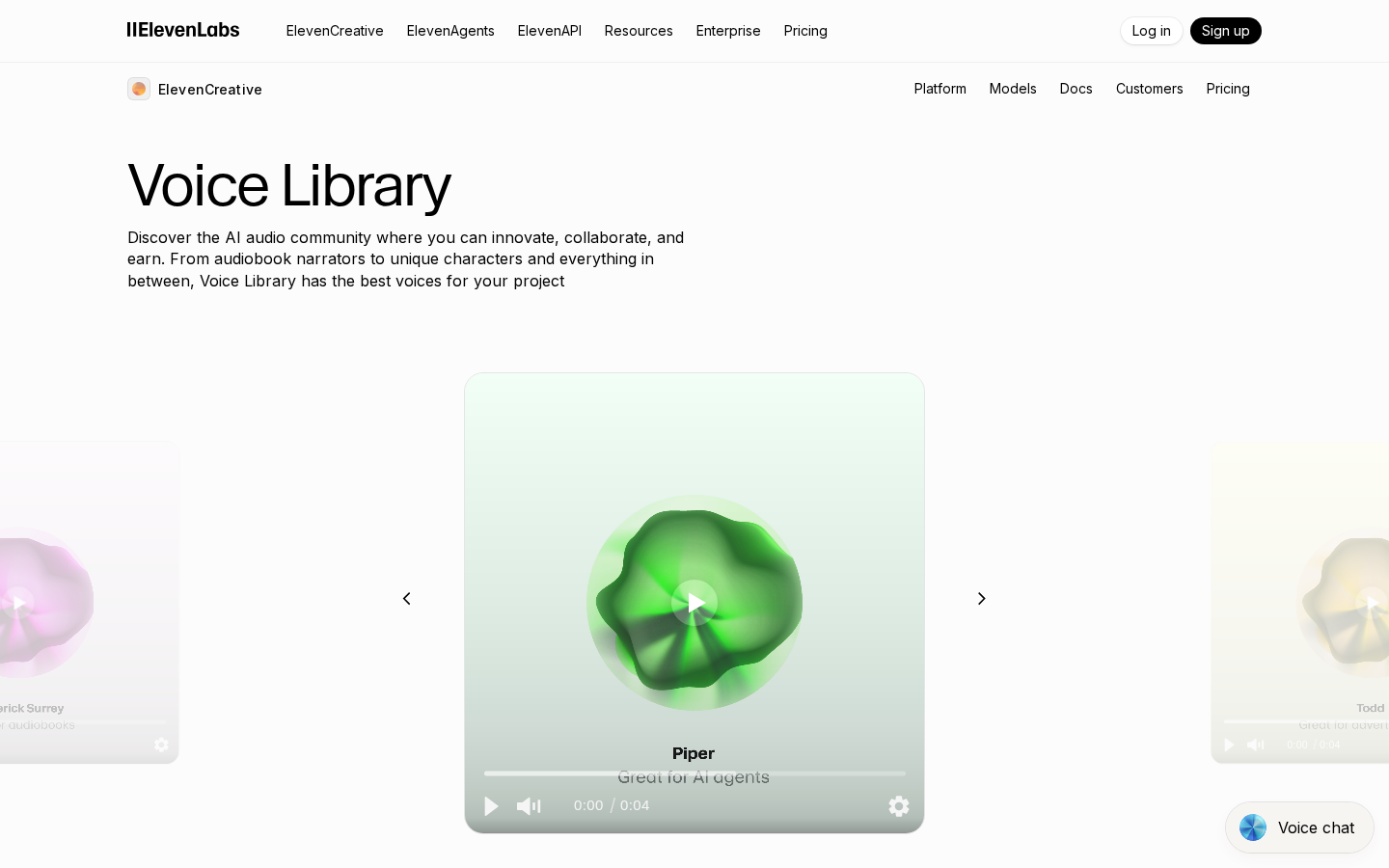
Voice cloning is where it gets interesting. The instant voice cloning feature requires just 30 seconds of clean audio – not the two to three minutes you need with some competitors – and the resulting voice consistently captures accent, pacing, and tonal characteristics of the source. I cloned my own voice from a 40-second recording and tested it on a three-minute script, and the output was crisp enough that I had to listen carefully to hear where the model was doing the synthesis. For content creators who want to scale production without hiring voice actors, or for businesses that want a branded voice but don't want to hire someone, this is genuinely powerful.
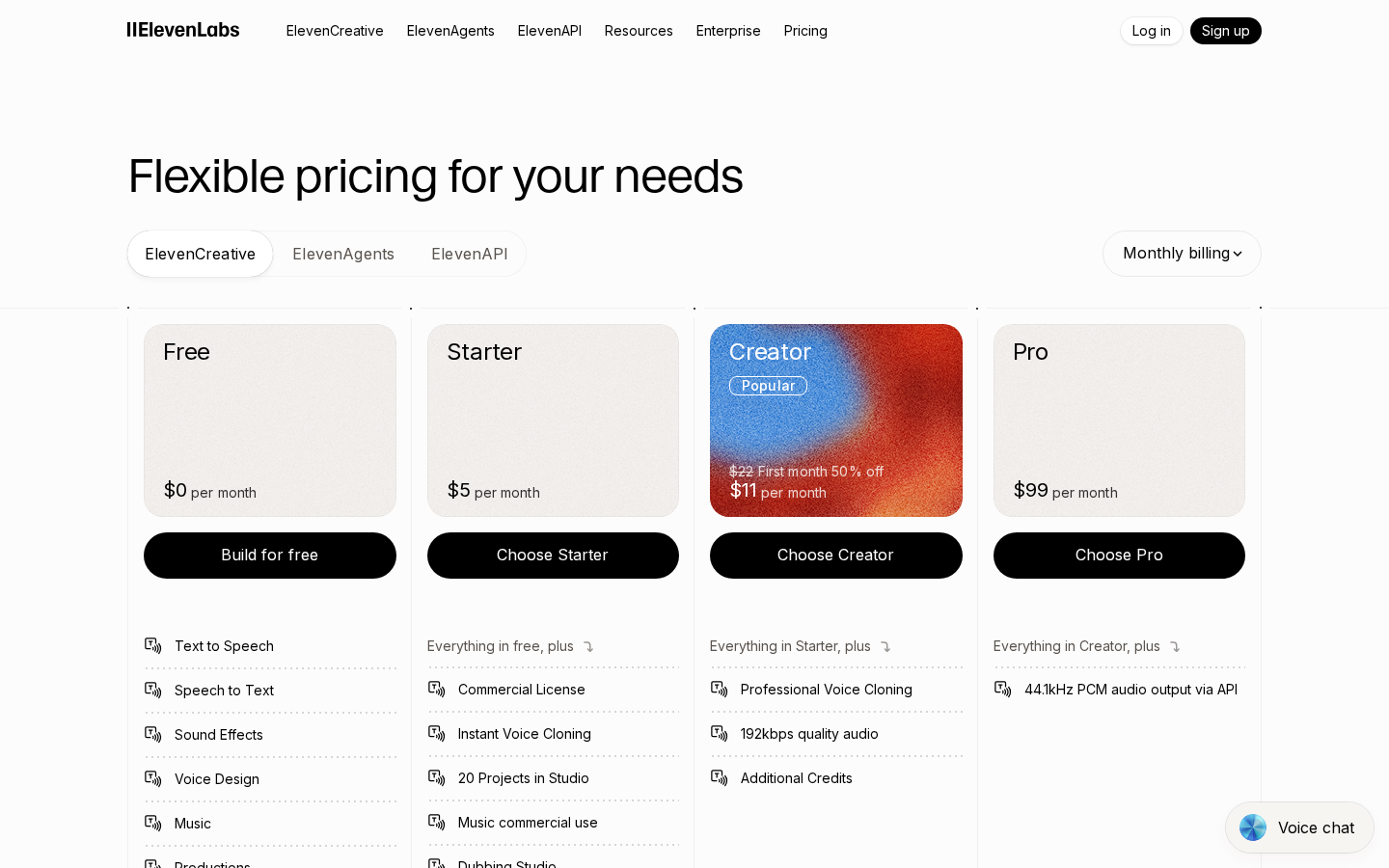
The pricing on voice generation is aggressive. Free tier includes 10,000 characters per month, which is roughly 10 minutes of audio. The Starter plan at $5 per month gives 30,000 credits and commercial license. Creator at $11 per month gives 100,000 credits, and Pro at $99 per month gives 500K credits with production-scale conversational AI agents. The per-character cost is remarkably low – lower than what you'd pay for a dedicated voice synthesis API like Google or Amazon, and with higher quality output.
Video Creation, Dubbing, and the Broader Platform
Here's where the unified-platform approach starts showing its limits. ElevenCreative can generate video with AI avatars, dub existing video into multiple languages, create subtitles, and handle multi-track audio editing – but it's not best-in-class at any of these things except arguably the audio part. The avatar quality is good but not quite at the level of HeyGen or Synthesia, who've invested more heavily in photorealistic avatar technology. The video generation is functional but lags behind what you'd get from a dedicated tool like Runway, which has more sophisticated motion control and scene understanding.
The dubbing feature is where the voice strength actually translates into a meaningful advantage. Dubbing multiple videos into multiple languages requires three steps normally – generate new voiceover in each language, sync it to the original video length, and then handle audio mixing. ElevenCreative collapses those steps because the voice generation is fast and the timing is usually tight. I dubbed a three-minute product demo into Spanish, French, and German and the whole process took maybe 15 minutes, with the voices coming out naturally and the sync reasonably close. HeyGen does this too, but ElevenCreative's voice quality advantage showed through pretty clearly in side-by-side comparison.
The conversational AI agents are interesting but still early. You can create voice-based chatbots that handle customer service or lead qualification, but the reasoning depth isn't there yet – it's better suited for scripted interactions than for complex problem-solving. This is a product that got faster and cheaper to deploy but doesn't have the contextual understanding that something like Claude or GPT would bring to the table.
AI Music and Sound Effects Generation
ElevenCreative added AI music and sound effects generation in the spring 2026 update, using models trained to create production-ready audio that fits naturally into video projects. The sound effects library is solid – you can generate ambient sounds, impact effects, transitions, and mood-setting audio from text prompts, and the output quality is decent for a v1 product. But this is an area where I want to be honest – it's not going to replace hiring a sound designer if sound design matters for your project. The generated music has that synthetic quality that's getting better but not yet transparent enough that you wouldn't notice it's AI-generated in a professional context.
Where this actually shines is in speed. If you're churning out social media videos or quick product demos where the background music and sound effects just need to exist and not distract, generating music in 60 seconds and sound effects on demand saves real time. I tested it on a series of LinkedIn product announcement videos and the speed advantage was substantial – instead of hunting through royalty-free music libraries or spending time in Splice looking for the right track, I was generating custom audio that matched the mood of each section in seconds.
Here Is What ElevenCreative Gets Right
Voice Quality That Actually Stands Apart
I keep coming back to this because it's the thing that matters most. The voice generation on ElevenCreative is noticeably better than Synthesia or HeyGen, and better than Google or Amazon's text-to-speech APIs. The audio is cleaner, the pacing sounds more human, and the emotional expressiveness actually works. Running multiple takes of the same script through different platforms made the difference almost obvious – ElevenLabs' output had less of that flattened, synthesized-voice quality that you get from competitors. This matters if you care about sounding professional.
Speed of Voice Cloning
Thirty seconds of audio to clone a voice is genuinely fast. Most competitors want longer samples, and some require studio-quality recording. I tested with a quick phone recording and the cloning worked well enough. The speed of the whole pipeline – upload clip, generate script, get output – is measured in minutes rather than hours. For content production that needs to move fast, this is a real advantage.
All-in-One Workflow for Simple Projects
If you're doing something straightforward – create a video, add voiceover, dub into another language, add music and sound effects – staying inside ElevenCreative means you don't have to wrangle multiple APIs or tools. The learning curve is shallower than learning three separate platforms. I built out a full four-language marketing video in about two hours, which wouldn't have happened nearly as fast if I'd had to coordinate between four different tools.
Where It Falls Short – And What Competitors Do Better
Avatar Quality Is Good But Not Best-in-Class
If photorealistic avatars matter to your project, HeyGen and Synthesia have invested more heavily and it shows. The ElevenCreative avatars are natural enough for many use cases, but they're noticeably less refined than what competitors offer. For customer testimonial videos or brand ambassador content where the avatar is the focal point, this is a meaningful gap. For voiceover-heavy projects where the avatar is background, it matters less.
Music and Sound Effects Feel Like v1 Products
They're functional and they're fast, but they have the character of early AI generation – useful for filler and mood-setting, not suitable for anything where sound design is part of the final product's character. If audio design matters, you're still going to hire someone or use dedicated tools. This feature set feels like a roadmap item that got released before it was fully polished, which isn't necessarily bad – it's honest about what it is – but you should know that going in.
Instruction Following Quirks
The platform has a habit of making decisions without asking. You set some parameters, hit generate, and it does something related but not quite what you asked for. I requested a specific pacing on a voiceover and got something faster. Asked for a particular mood and got something more neutral. These aren't deal-breakers but they require iteration, which kills the speed advantage. Dedicated tools like Synthesia tend to be more predictable in what they output relative to your inputs.
Export Options Are Narrower Than Competitors
HeyGen lets you pull out individual elements – just the video, just the audio, with or without subtitles, in various formats. ElevenCreative bundles things more tightly. If you need granular control over what you're exporting, you'll find ElevenCreative constraining. You can get your final video in most standard formats, but pulling intermediate assets is harder, which limits how much post-production work you can do downstream.
ElevenCreative Pricing and How It Compares to Synthesia and HeyGen
ElevenCreative Pricing (April 2026)
- Free: 10,000 characters/month, 30 sec avatar video limit
- Starter: $5/month, 30K credits, commercial license, instant voice cloning
- Creator: $11/month, 100K credits, pro-grade voice cloning, music/SFX generation
- Pro: $99/month, 500K credits, production-scale conversational AI, priority support
- Scale: $330/month, Business: $1,320/month (custom enterprise pricing)
- Annual billing saves ~17% across all tiers
The credit system is where you need to pay attention. Voice generation costs fewer credits than video generation. A 60-second video with voiceover and music might cost 300-500 credits. At the Creator tier, 100K credits costs $11/month, which works out to roughly $0.00011 per credit – cheap enough that you're unlikely to hit your limit unless you're doing serious production volume. The free tier isn't a joke – 10K characters lets you test the voice generation reasonably thoroughly before you commit to paid.
How This Stacks Up
Synthesia's Creator plan is $20/month for 50 video minutes and 10K voice characters per month. HeyGen's Creator plan is $23/month for 25 video minutes. ElevenCreative's Creator plan is $11/month, but you need to understand that the credit system is somewhat opaque – you don't get unlimited video generation, you get credits that can be used for various combinations of voice, video, music, and effects. For someone planning to do a lot of voice generation and less video work, ElevenCreative is cheaper. For someone wanting straightforward video creation with unlimited avatars, Synthesia or HeyGen might be clearer value.
None of these platforms are expensive, so the decision isn't driven by price – it's driven by capability and workflow. ElevenLabs' affiliate program at 22% recurring commission is also more generous than most competitors, which I mention because if you're building tools that integrate with voice APIs, ElevenLabs is worth taking a close look at.
Who Should Use ElevenCreative (and Who Should Look Elsewhere)
ElevenCreative is genuinely the right choice if you:
- Do high-volume voice generation and want the absolute best voice quality available on any platform – this matters if your brand voice is important or if you're doing something where people will listen closely to audio quality
- Spend significant time on voice cloning and need 30-second quick turnaround to test voices before doing full production
- Want to dub content into multiple languages and care about voice consistency across languages – this is where the voice strength translates into a concrete workflow advantage
- Build products or services where voice is core – voice apps, audio content, voiceover production – and you need API-level reliability and speed
- Are building one comprehensive creative tool and want to avoid juggling three separate platforms for basic projects
You're probably better served by Synthesia or HeyGen if:
- Photorealistic AI avatars are central to your project and you want the most refined avatar experience available
- You're primarily doing video creation and the voiceover is secondary – dedicated video platforms have invested more in video quality and avatar customization
- You need granular export control and want to do significant post-production work after generation
- You want straightforward per-video pricing rather than a credit system that requires calculating conversion rates
- Sound design matters for your project – neither ElevenCreative nor the alternatives have production-grade audio generation yet, but dedicated sound design tools still beat platform-generated music
The practical recommendation I'd make is this: start with ElevenCreative's free tier and test the voice quality on something that matters to you. If you like what you hear – and most people do – the Creator plan at $11/month gives you room to explore. If you find yourself needing better avatar quality or more granular video controls, then test Synthesia or HeyGen on the same project. The platforms are designed so you can run a decision process like that, and the cost of testing is low enough that it's worth doing before you commit to one tool as your default.
Final Thoughts
ElevenCreative is the most refined voice generation platform on the market, and ElevenLabs is clearly making a bet that the future of creative work is unified – one tool that handles voiceover, video, music, and effects at reasonable cost with decent quality across the board. I think they're partially right. The voice strength is real enough that it justifies paying for the platform even if you use the other features sporadically. But they're not fully right yet – the video quality and avatar realism still trail dedicated platforms, and the music and sound effects generation feels early.
If I were an agency or content studio doing high-volume work, I'd probably use ElevenCreative for voiceover and dubbing and keep a dedicated video tool like HeyGen or Synthesia for projects where avatar quality is the focal point. That's not a knock on ElevenCreative – it's just honest about where the platform has invested and where the tradeoffs are. For someone building a single content business though – a YouTube channel, a podcast, product demos, customer testimonials – starting with ElevenCreative and moving to specialized tools only when you hit the ceiling makes sense. The voice quality is good enough that it's worth building your workflow around, and the cost is low enough that you're not locked in if you need to add something else later.
The platform is moving fast. They added music and sound effects generation in spring 2026, they're clearly investing in avatar quality, and the Eleven v3 model with expressive audio tags is a meaningful step forward. If ElevenCreative keeps iterating at this pace, the gap between it and specialized platforms will keep narrowing. For now, it's the best single investment if voice quality is your priority and you want a simplified workflow. If avatar quality or sound design are your north star, you'll probably need to piece together multiple tools.
Affiliate Disclosure: ElevenLabs offers a 22% recurring affiliate commission. If you purchase a subscription through links in this article, StackBuilt AI may earn a commission at no additional cost to you. We only recommend products we have personally tested and believe in. Read our full affiliate disclosure.


